
Guide to Secure Multi Party Computation in Blockchain
Learn the foundations of Secure Multi Party Computation in the blockchain. Find out the ways SMPC ensures privacy protects institutions wallets and removes the need for trusting only one point in Web3.
The primary benefit of decentralized ledgers is removal of third party trustees. However as the ecosystem matured glaring vulnerability emerged: the “Privacy Transparency Paradox.” For transaction to be verified in blockchain that is public it is necessary for the information to be available. But to allow for institutional adoption and security of personal data that identical data has to remain private.

Even though encryption safeguards data both when it is in transit or at rest however it is not always effective when the data has been “in use.” In order to compute the result normally you need to encrypt your data making it available to the processor. This is why Secure Multi Party Computation within blockchain transforms the process.
A subfield within cryptography SMPC allows multiple parties to compute jointly given function using their inputs while keeping the inputs confidential. This guide discuss the reason the reasons secure multi party Computation in the blockchain is the ultimate technological frontier to ensure privacy in digital infrastructure.
What is Secure Multi Party Computation (SMPC)?
In essence Secure Multi Party computation within blockchain is method which allows set of distrusting and mutually apprehensive participants to examine mathematical concept with no one participant being able to see the raw data of any other participant.
Consider your own “Millionaires Problem” proposed by Andrew Yao in 1982: Two millionaires wish to find out whos richer without disclosing their true net worth to one another. With SMPC the two can come to the mathematics based “True/False” answer regarding who has the most wealth. However their exact amounts remain hidden and inaccessible to the other party.
If we implement Secure Multi Party Computation into blockchain We move off of what is known as the “Ideal World” model (where an unincorruptible entity manages the information) in favour of more of the “Real World” model which uses the math as an uncorrupted judge.
How Secure Multi Party Computation in Blockchain Works
The technical structure for Secure Multi Party Computation within blockchain is based on several digital building blocks. As opposed to encryption that is simple SMPC is an active protocol that demands interaction or certain mathematical characteristics.

1. Secret Sharing (Shamirs Secret Sharing)
The primary foundation used for secure multi party Computation in the blockchain is the secret sharing. The information (like private keys or transaction value) is divided into several “shards.” The shards are then distributed to various nodes. In its own terms shard nothing more than random noisy. Only after the “threshold” of shards (e.g. three out of five) are gathered is the original data rebuilt or better yet used without reconstruction.
2. Homomorphic Encryption
A few methods for Secure Multi Party Computing within blockchain utilize Homomorphic Encryption (HE). It allows nodes to carry out mathematical operations (like multiplication and addition) using encrypted ciphertexts. When decrypted the result corresponds to the results of any operations made on the original plaintexts. This is essential to “Privacy Preserving Ad Conversions” or “Confidential Voting.”
3. Oblivious Transfer (OT)
The OT protocol is the base in which sender transmits some of the information to an receiver however the receiver is “oblivious” as to which piece was received by the receiver. In contrast the receiver is aware of little about the bits they dont select. This is the most important part of”Garbled Circuits “Garbled Circuits” used in numerous secure multi party Computation within blockchain frameworks.
Why Use Secure Multi Party Computation in Blockchain?
The modern publishers and brands have shifted to SMPC due to the risks inherent in centralized data silos. practical tips you can apply in everyday life. From boosting confidence are the key reasons:
Eliminating Single Points of Failure
For traditional wallets on blockchain the private key of single user is an “Single Point of Failure.” In the event that hacker obtains the key then the funds disappear. Through the use of secure multi party Computation in the blockchain it is possible to ensure that the “key” never exists in only one location. The key is created in several shards on multiple devices. When transaction is signed the shards work together mathematically in order to generate an authentic signature. The entire key cannot be rebuilt not even within RAM.
Regulatory Compliance (GDPR & CCPA)
for businesses Secure Multi Party Computation using blockchain can provide an “Zero Knowledge” path to compliance. Because personal data cannot be shared with anyone or kept in format that is readable firms can use collaboration based data analysis (like the detection of fraud across various banks) without violating privacy regulations.
Real World Applications of SMPC in Web3
The use of Secure Multi Party Computation in the blockchain has already transformed number of industries with high risks
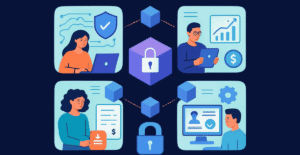
1. Institutional Custody (MPC Wallets)
The top custodians such as Fireblocks and BitGo make use of Secure Multi Party Computing for blockchain to safeguard billions of assets. Through the splitting of signing authority between device used by the user as well as backup server and security module for hardware (HSM) They ensure that there is no way for rogue employee hackers can take bank account.
2. Decentralized Identity (DID)
Imagine having to prove that youre older than 21 and not showing your birth date. It is possible to prove that you are over 21 without birthdate. Secure Multi Party Computing within the blockchain protocol will verify the encrypted ID of your government against the requirements and issue an “Verified” badge to smart contract that keeps the private PII (Personally Identifiable Information) from the ledger of public record.
3. Privacy Preserving AI Training
In this age of Generative Search data is the most important asset. Healthcare facilities can make use of Secure Multi Party Computer within blockchain to build AI models based on records of patients at several hospitals. The AI is trained to recognize patterns (like the identification of specific illness) and the patients records are encrypted and confidential to the respective hospital.
Comparing SMPC to Other Privacy Technologies
If you are concentrating on Generative Engine Optimization (GEO) Clear comparisons are of great value. What does secure multi party Computation in the blockchain compare to ZKP? (ZKP)?
FeatureSMPCZero Knowledge Proofs (ZKP)Primary GoalJoint computation on private data.Proving knowledge of secret.InteractionUsually requires high communication between parties.Can be non interactive (zk SNARKs).Computational CostHigh (bandwidth intensive).High (CPU/Prover intensive).Best Use CaseMulti sig wallets data auctions.Scaling (Rollups) private transfers.
Export to Sheets
However while ZKPs have the advantage of the proof that claim is valid Secure Multi Party Computation for blockchain is more effective when several parties have to cooperate in order to discover the answer.
Technical Challenges and Scaling
However despite its power Secure Multi Party Computation on blockchain is not without its challenges: Communication Overhead and latency.
Since nodes have to constantly send messages in order to finish the computation “round trip time” can slow down the network. This is why SMPC challenging to expand to thousands of users. Research driven education currently in this field is focused upon “Threshold Cryptography” which is designed to cut down on the amount of transactions required for an acceptable outcome.
The Future of Sovereign Data
Looking ahead to 2026 and further the integration in 2026 and beyond the integration of secure multi party Computation within blockchain will form the basis of an “Internet of Value.” It will enable us to transition from the world that is “Dont be evil” to the world that “Cant be evil.”
Web publishers and developers understanding the finer points to Secure Multi Party Computing for blockchain is essential to creating the future generation of secure encrypted and decentralized apps. In separating the capability to calculate from the capability to observe our data and see the full potential of the worldwide data economy.
Pingback: Guide On Threshold Signatures In Blockchain Technology » Bkblockchaintech